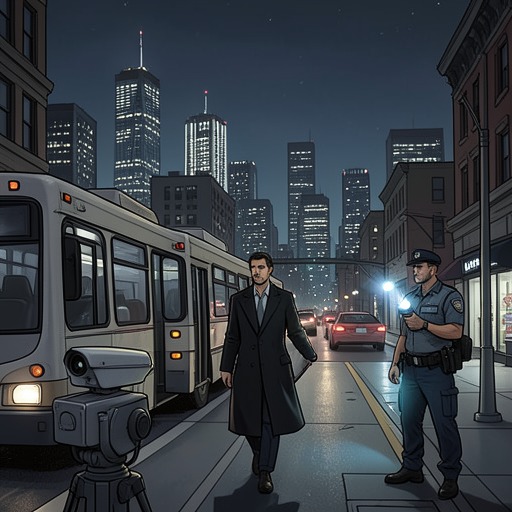
Timbre takes a night bus back to the shelter
Hayden's TimbreTimbre takes a night bus back to the shelter after deliberately waiting for Hayden Devillier’s truck to disappear from the apartment complex where he has left her. The journey is meant to preserve her secret and her independence, but it exposes how little safety her precarious circumstances provide: a dark complex, a poorly monitored bus, predatory passengers, multiple transfers, and an exhausted return to the shelter. The episode becomes a decisive test of the distance between self-reliance and genuine security, and its consequences continue to shape Timbre and Hayden Devillier’s relationship.
Causes and Circumstances
Timbre’s journey begins as a retreat from confrontation. After Hayden Devillier leaves, she waits until his truck vanishes before moving toward the gate, where a bus stop offers a way back to the shelter. Her choice is practical but also defensive: she would rather endure an inconvenient and dangerous trip than reveal that she does not actually live in the apartment complex. The surrounding darkness and poor lighting already make her uneasy, yet the nearby bus stop appears to offer the only workable exit.
The decision follows a breach of trust between them. Hayden Devillier has become suspicious of Timbre’s explanation of where she lives, while Timbre believes that concealing the truth is necessary to preserve control over her life. The bus therefore carries more than a passenger. It carries the pressure of her economic insecurity, her fear of dependence, and the immediate consequences of trying to maintain a false appearance of stability. Her later admission that she chose the route because a stop stood outside the gate confirms that the transportation plan was deliberate, not accidental, even though she had not fully anticipated its risks.
The Ride and the Threat
Timbre chooses a seat near the driver, hoping that proximity to the person responsible for the bus will keep her safe. Instead, several older teenage boys board and sit directly behind her. They speak in a mixture of broken English and Spanish, laugh while looking at her, and make her feel that she is the subject of their conversation. One leans close and taunts her with, “What’s the matter, babe? Worried we’re gonna do something you might like?” She refuses to answer, recognizing that a response could encourage further provocation.
The threat becomes physical when a taller boy sits beside her and crowds her against the wall. The driver appears not to notice what is happening. The young man runs a finger down her arm, then tells her, “We can give you a real sweet ride, puta.” His companions laugh when she remains silent, and he continues questioning her when she does not understand the language being used around her. The scene turns the bus into a confined space in which Timbre has no clear route of escape: she is isolated, pressed against the vehicle’s side, watched by the other passengers, and unable to rely on the driver’s intervention.
The arrival of two police officers changes the immediate balance of power. When they board at the next stop, Timbre feels relief; the young men move toward the other doors and leave the bus. She grips the railing separating her from the driver and breathes deeply, using the officers’ presence as the protection the driver has not provided. The danger ends without a physical assault, but the episode does not become harmless. The harassment, unwanted touching, confinement, and uncertainty have already demonstrated how quickly ordinary transportation can become a crisis for a woman traveling alone at night.
Return to the Shelter and Disclosure
The trip does not end quickly. Timbre changes buses twice after discovering that her first stop is not served by a route going near the shelter. By the time she reaches her destination, exhaustion has overtaken the fear. She enters quietly, removes only her shoes, and collapses onto the bed, sleeping on the shelter’s disposable pillow. When she wakes around noon, the shelter has emptied, and she must prepare for a work shift despite having slept fitfully after the night’s near disaster.
The incident also intensifies her awareness that Hayden Devillier knows less than he thinks he does. She has managed to anger him, suspects that he understands more about her situation than he admits, and still has no way to tell him that the apartment was not her home. Her concealment protects her from immediate exposure but leaves her carrying the danger alone. Later, when Hayden Devillier learns how she traveled, Timbre explains that she rode the bus because a stop was located directly outside the gate. The simple explanation cannot disguise the risk of the decision.
Hayden Devillier’s response is anger driven by fear. He tells her that the men could have taken her from the bus, forced her off with a gun or knife, or harmed her while the driver failed to notice. He condemns her for traveling alone in the middle of the night, then immediately recognizes that yelling will not solve the danger and pulls her into his arms to apologize. The movement from accusation to embrace captures the central tension of the episode: his protection is emotionally sincere, but it arrives in a form that can feel controlling to someone determined not to depend on anyone.
Recurrence and Escalation
The night bus becomes a recurring measure of Timbre’s vulnerability. Later, when she takes a bus alone from Mountain Grove to obtain supplies, Hayden Devillier again reacts with alarm because he knows the road is busy and dangerous and cannot imagine a safe stop there. The earlier harassment has made his concern concrete rather than abstract. What Timbre experiences as an economical, manageable solution appears to him as another exposure to people and circumstances that could remove her ability to choose.
The pattern reaches a far more violent stage when Krissy Thompson and Ella Sullivan abduct Timbre. After drugging and assaulting her, they bind her hands, threaten her with a knife, and demand that she disappear from Austin and leave Texas altogether. Krissy Thompson uses Crew Devillier as leverage, threatening permanent injury to the child if Timbre returns or contacts Hayden Devillier. Timbre’s compliance is therefore a survival strategy under coercion, not consent: she agrees to leave, asks only that Crew Devillier not be harmed, obtains access to money, and is placed on a bus while the kidnappers follow by car beyond the city limits.
This later forced journey echoes the earlier night ride while reversing its terms. The first bus trip is Timbre’s chosen attempt to conceal her circumstances; the second is an imposed expulsion backed by weapons, bodily violence, economic threat, and the threat against Crew Devillier. In both cases, a bus represents movement without safety. The difference is that the later journey makes explicit the coercive structure that the earlier episode only foreshadows: control works through isolation, restricted movement, financial vulnerability, and threats against someone Timbre loves.
Consequences and Significance
The night bus episode changes how Hayden Devillier understands Timbre’s life and how Timbre understands the cost of refusing help. Its immediate consequence is not a breakup but a negotiation of trust. Hayden Devillier insists that Timbre use his number when she needs help, a ride, or anything else, and she promises not to repeat such a dangerous situation. The exchange does not erase her independence; instead, it gives that independence a new boundary, acknowledging that accepting assistance can be a form of self-preservation rather than surrender.
The scene also prepares the emotional logic of the later rescue. When Hayden Devillier learns that Timbre Simons is at the police station in Amarillo after calling 911 and reporting that she was kidnapped, the earlier fear of losing her to an unsafe journey becomes a confirmed emergency. Ryan Powell sends a plane, and Hayden Devillier reunites with Timbre at the small airport. He asks whether she has been hurt, embraces her, and then joins Timbre and Crew Devillier in returning home. The contrast is stark: the night bus carries Timbre alone toward a shelter, while the plane brings her back toward a chosen family that has mobilized to find her.
As a narrative event, Timbre takes a night bus back to the shelter belongs to the romance’s movement from guarded distance toward mutual reliance, but it also functions as an early rescue plot in miniature. Timbre survives through silence, vigilance, strategic waiting, and eventual access to public authority; Hayden Devillier learns that protection must include listening and practical support, not only reprimand. The episode’s lasting significance lies in that double recognition. It exposes the material dangers of homelessness and housing insecurity while showing why Timbre’s eventual acceptance of a safer home is emotionally difficult: dependence threatens the self-reliance that has helped her survive, yet isolation leaves her vulnerable to dangers she cannot control alone.